

Swisca News
Process optimisation for the milling industry
Digitalizing data and making data available for electronic data processing is a trend in the milling industry. Fewer errors and falsifications are occurring or errors can be excluded in comparison to analogue processing. In the operational processes of a mill operation, digitalisation enables an increase in efficiency and thus an improvement in its economic efficiency. The data generated in digital form with innovative, high-precision weighing systems are also suitable for optimising processes.
For example, by measuring mass flows, the density and moisture of oat flakes, the production processes can be optimized and automated with electronic data processing systems. In order to ensure a constant quality of the end products, the parameters of flaking and drying must be continuously monitored and, if necessary, adjusted. The generated data are also used in digital form for an optimal composition of grain mixtures and for the regulation of a predetermined capacity with quantity controllers, thus improving the accuracy of the dosing. Measurements of several force components and vibration measurements of the impact plate system allow highest precision by means of electronic data processing.
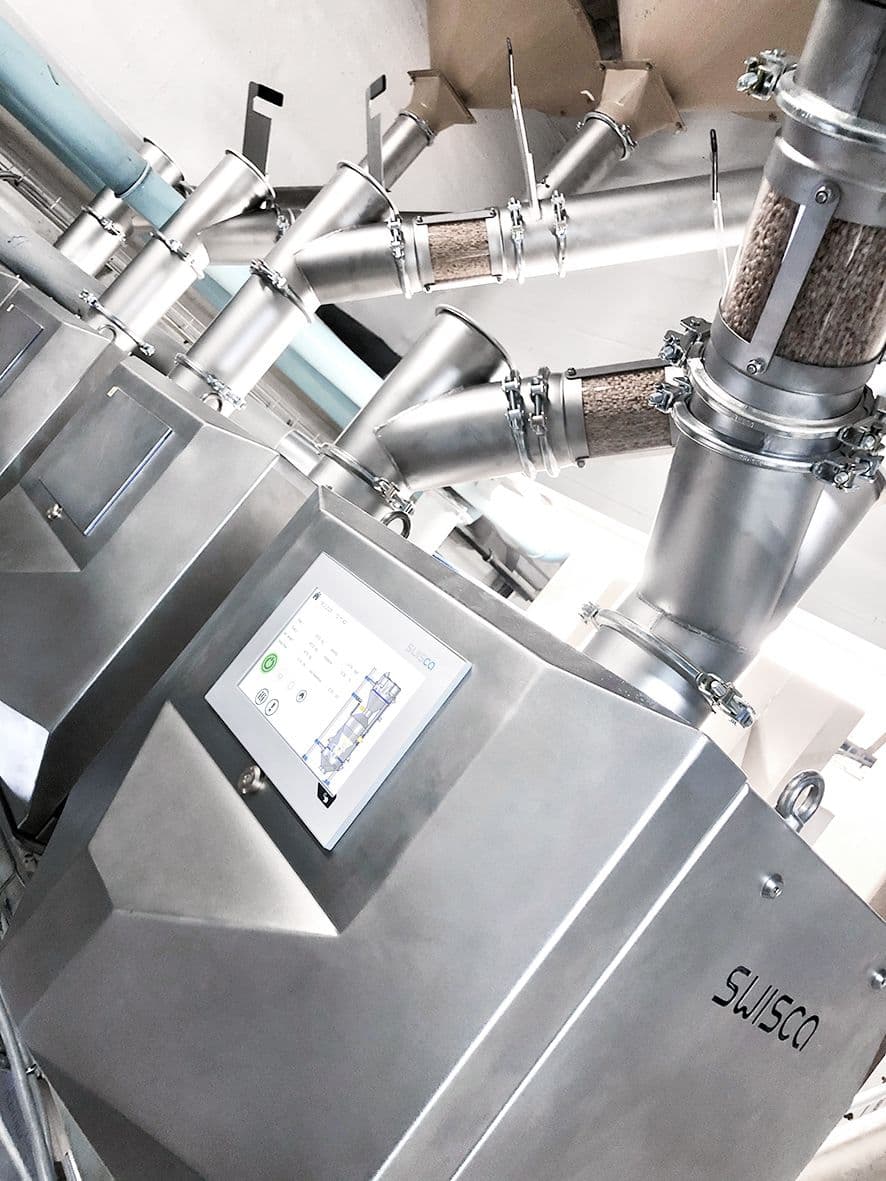
The heart of the scales, flow controllers and micro dosing scales for the mill industry is the control system. A state of the art control of weighing system is equipped with very robust, userfriendly and reliable touch screen. Web server modules for cloud solutions and remote maintenance enable optimal data access and use for yield calculation, product traceability and inventory. Scales can be operated autonomously or connected to a plant control system and ERP systems. Ethernet-based ProfiNet and EtherNet/IP fieldbus modules or Profibus and the RS 485 interface are used for this purpose. In case of a power failure, the scales close in a controlled manner and all data is saved in the scale control system. In many mills, scales with 20 to 30-year-old controls are installed. Spare parts are often no longer available, and the interfaces are obsolete. Scale controls can easily be replaced by a moderncontrol system and the production data can be optimally used.
The trend towards process optimization with intelligent weighing systems in the milling industry not only saves costs and supports the millers. Digitalization and a sensible application of technical possibilities open new opportunities for data acquisition and process regulations and thus facilitate the work of the operating personnel.
