

Swisca News
Improved Grain conditioning for consistently high Milling Yields
Dampening is a key production process in a mill to support uniform grinding conditions and set the basis for consistently high Milling Yields. Dampening Grain results in two important benefits for the first preparing the grain for optimal grinding conditions and secondly adding water for commercial gain. By adding water to grain and tempering it in, the bran layers become tough and elastic, the endosperm is mellowed. This is the optimal condition for separating them most efficiently during the grinding process. In order to get most benefit out of the dampening process, it is important that the water is distributed as uniformly as possible onto the surface of the kernel, allowing it to penetrate evenly into the endosperm in the tempering bins. Dampening is traditionally an energy-intensive production process and is critical in terms of sanitation and therefore food safety. In addition to the technological and economical aspects, microbiological impact has gained in importance. The requirements to meet or exceed food safety standards are increasingly challenging.
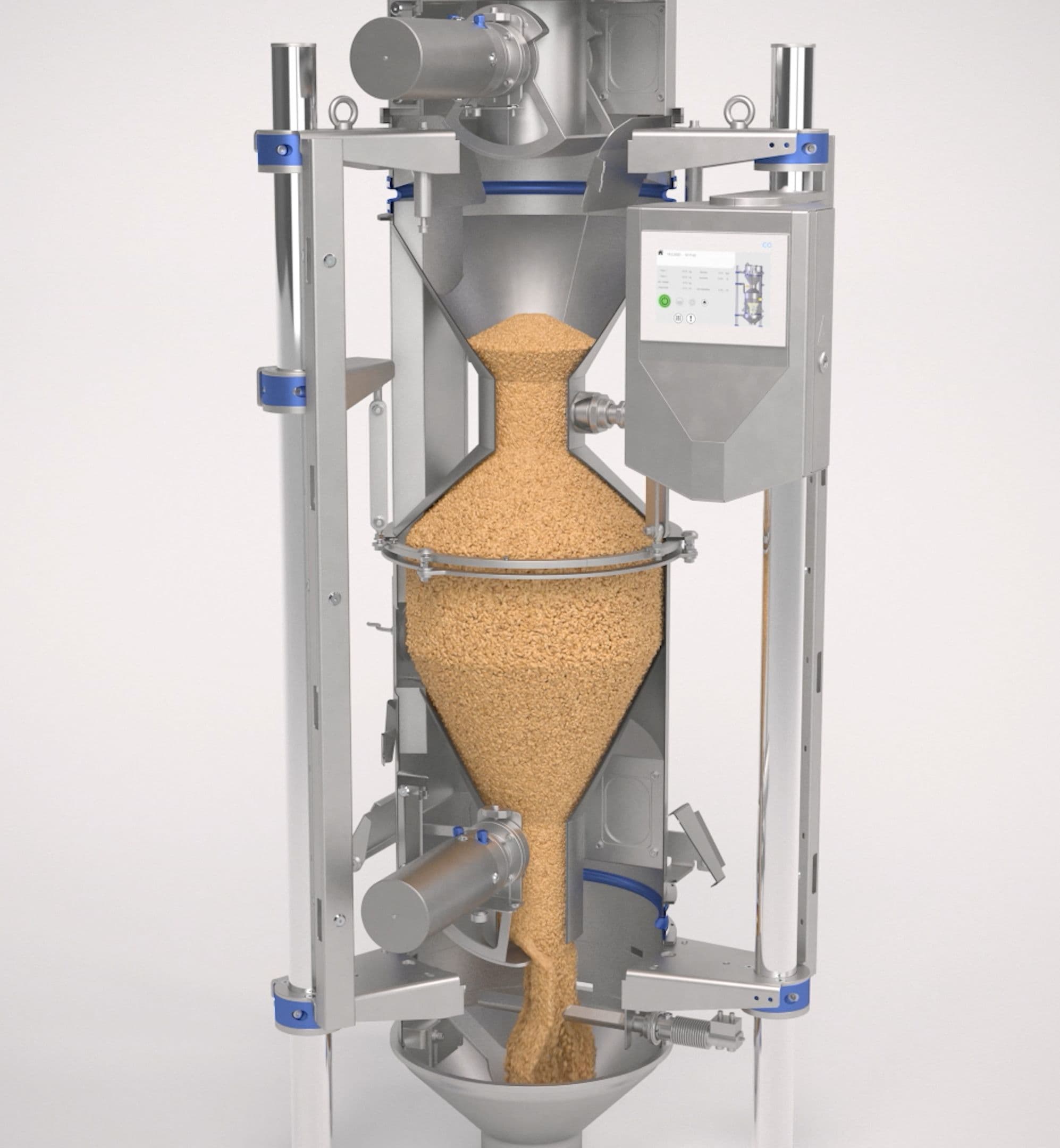
Besides measuring the product throughput online, the differential dosing scales are used in addition to other constant and accurate measurements on grain, such as moisture, density and temperature. For an accurate data collection from the grain, required for the milling process, product temperature, density and product moisture content are necessary. The measurement of mass flow and product moisture depends on density. An innovative control system allows easy calibration of the capacitive moisture sensor and accurate comparison with empirical values determined in the laboratory. Differential dosing scales with innovative additional equipment measure the mass flow and register the total weight with even higher accuracy than conventional equipment. State-of-the-art control technology and weighing algorithms, process the measurement after the dosing slide even when the scale is refilled. This additional impact measurement eliminates uncertainties when refilling the scale and is improving the measurement accuracy by approximately. Thanks to this additional measurement, the system always works gravimetrically, and the opening of the dosing slide can be monitored and readjusted continuously. The advantages of the high accuracy and the continuous process of a differential scale are optimally combined. The improved accuracy of the scale is an advantage for providing consistent dampening conditions allowing for very precise water addition.
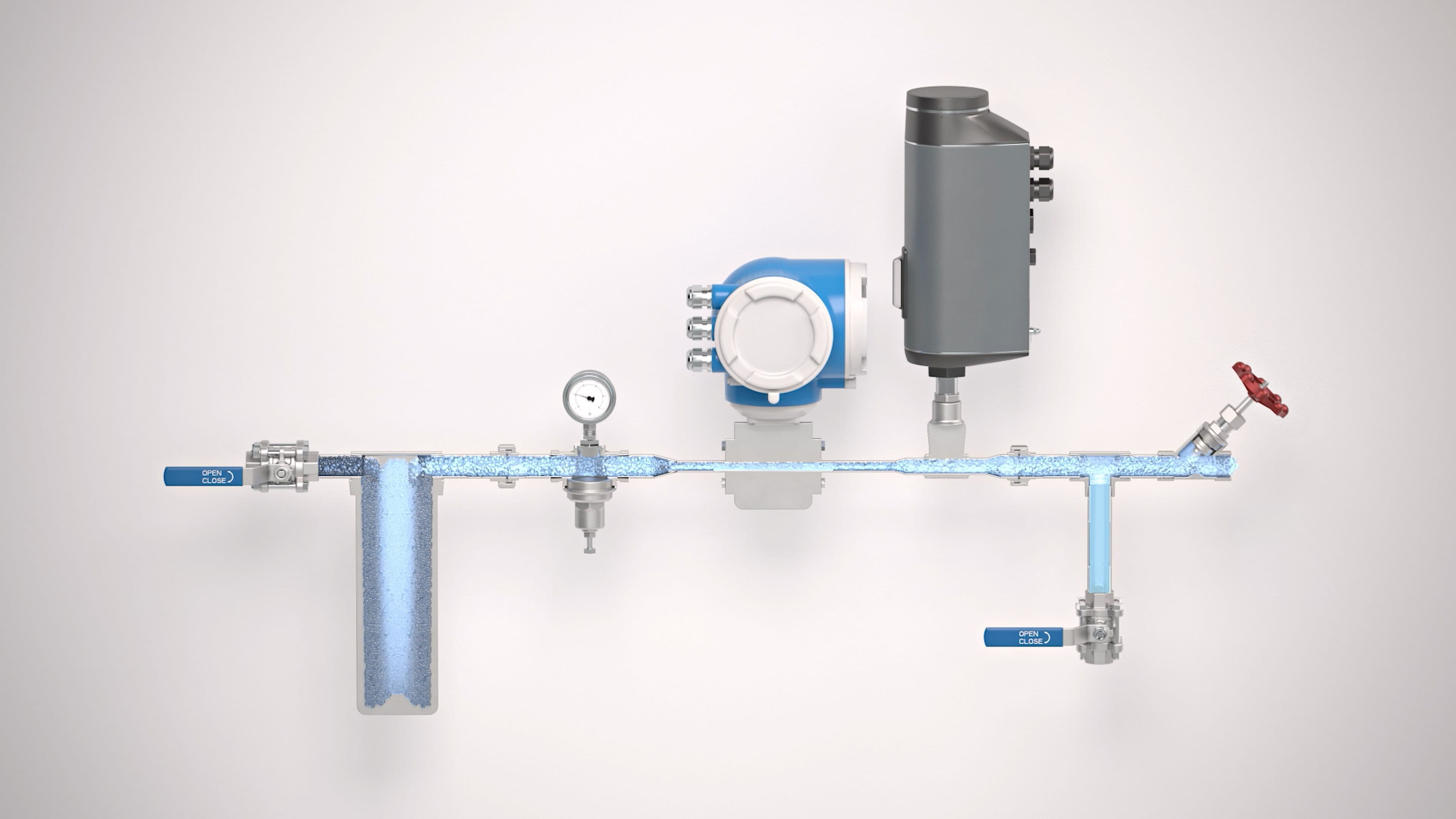
The automatic liquid flow controller and the differential dosing scale with the moisture determination system are optimally matched to each other for an exact addition of the water quantity. The differential dosing scale measures the product flow rate and moisture simultaneously. The control system calculates the required water quantity and controls the liquid flow meter and the dosing slide very precisely. The continuous measurement and control of mass flow, moisture, temperature and the calculation of the required water addition with a multifunctional weighing system enables efficient process control. High-quality control valves with electromotive positioners and energy storage enable a wide dosing range. The accuracy of the metered quantity of water is significantly impacted by the quality and accuracy of the flow meter. A correctly designed water filter is essential to separate any contamination that could be caused by the water. The automatic liquid flow controller is also suitable for chlorinated water (55°C, 600 ppm) or steam and is manufactured in a sanitary design and consists of stainless steel. There is no need for any additional electrical control unit to measure water flow or moisture content in grain.
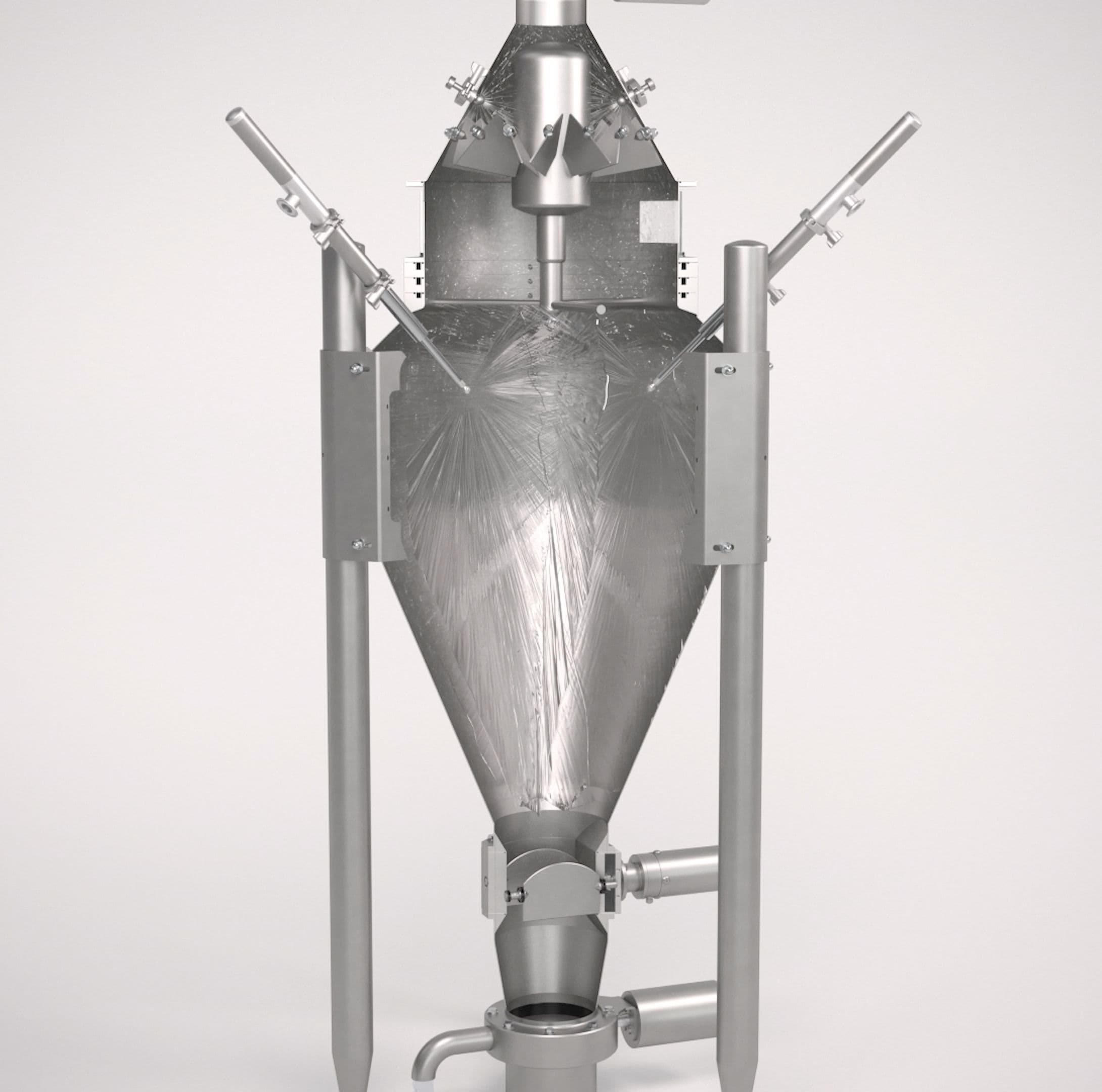
Grain dampening in milling is a commonly used process. Water addition rates as high as 7% are possible with minimum abrasion and breakage of the product. In flour mills, dampening of wheat is a critical control point. Most dampening machines need to be cleaned on a regular basis. Once the machine is turned off, growth of germs and bacteria does occur. The negative impact is visible and is usually causing a distinct smell. The expected bacteria growth can be confirmed with Laboratory test data if required for reference. Inside conventional dampeners, abrasion dirt and remaining grains must be removed manually to avoid or limit contamination. If the dampener is not operated for a longer period of time, a potential risk of microbiological contamination of the grain that follows cannot be ruled out. When this contaminated wheat reaches the mill, the flour produced from it will also have an increased number of microbiological counts. Innovative dampeners minimise the risk of contamination and allow for automatic cleaning-in-place (CIP). Some situations are asking for a very small addition of water with an even distribution on the surface of the kernel. This can be a real challenge. In this case the machine shown below can be the correct solution. innovation of dampener forms the flow of the grain into a curtain by means of a baffle spike and slats. The added water is atomised into fine drops via nozzles arranged radially on both sides. These droplets collide with the falling grains and adhere to the surface. If the production process allows it, an automatic cleaning cycle is carried out in between. Extendable rinsing nozzles are actuated by the cleaning medium for optimum cleaning of the entire interior. The waste water of the cleaning process as well as the disposal of the collected residuals, is typically automated.
The trend towards process optimization with intelligent systems in the milling industry not only saves costs but also supports the millers and improves their operational excellence. Energy-saving solutions with accurate mass flow, density and moisture measuring, sanitary water addition technology, the resource-efficient dampening process and cleaning-in-place technology are designed to bring your Grain conditioning System to the next level. This next generation of moisture management system is sustainable, requires less equipment and plant controls, significantly less energy and is a major step forward towards meeting or exceeding the most stringent food safety standards.
